Work in Progress
Abstract
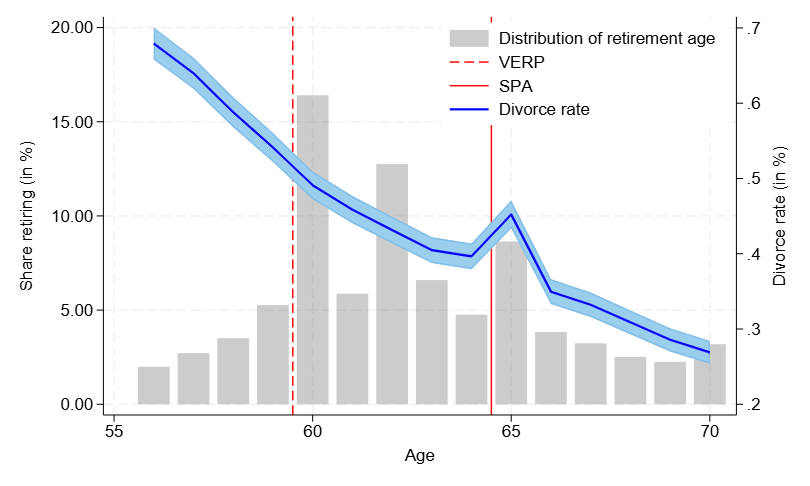
Social insurance programs often make benefits a function of household size, to account for economies of scale in consumption of couples. Due to endogeneity problems, empirical estimates of responses to such policy design are sparse. This paper aims to fill the gap by exploiting variation around exogenous age thresholds in a state pension with this feature. In response to a near-universal change in incentives to living alone, we estimate an increase in the share living alone of 0.2% pt (0.8%). This is driven by a permanent 5% fall in new cohabitation starts and a one-off 20% spike in the risk of separation and divorce. The findings are robust to controlling for kinks in mortality, timing of actual retirement, and we find little evidence of fraud.
Abstract
Over the past two decades, the likelihood of divorce after age 50 has doubled. This means that divorce is increasingly occurring at ages when accumulated pension wealth constitutes a large share of household resources and gender gaps are significant. Given the large variation across countries in whether and how pension wealth differences are compensated in divorce, this raises the question of how well individuals are insured against the financial consequences of grey divorce. Using administrative data from Denmark, a country that treats pension wealth as separate property, we show that divorce is associated with delayed retirement for women in particular. We then build a dynamic structural model of household bargaining, divorce and retirement explore what insurance mechanisms divorcees use to mitigate the impact on consumption in retirement and how this interacts with counterfactual policies for the division of pension wealth. We find that compensation of pension wealth differences in liquid assets only has a small effect on the retirement of divorced women while instead being used to smooth out consumption around divorce. In contrast, in-kind division of pension wealth causes earlier retirement of divorced women. When state pension benefits are means tested, in-kind pension sharing also reduces divorced women's reliance on public pensions by increasing their private pension income.
Abstract
Accurately modelling interdependence of labour supply decisions of individuals living with a partner is crucial for understanding women’s labour market participation. For this purpose, I describe how a recently proposed generalisation of two-agent models that covers the whole spectrum from non-cooperation to perfect cooperation can be used to study couples’ labour supply and housework division. Whilst generally increasing levels of caring raises individual and household utility, this is not the case when caring is very asymmetric. Furthermore, in this model a rise in the wage of the lower earner decreases utility of the higher earner due to the effects on within-household distribution of consumption. This is not the case for household productivity: all else equal, the partner who is less productive in the household has higher utility. And, lastly, whilst labour supply elasticities increase with within-household wage inequality, they do so at a higher rate for couples with high cooperation and vice versa.